
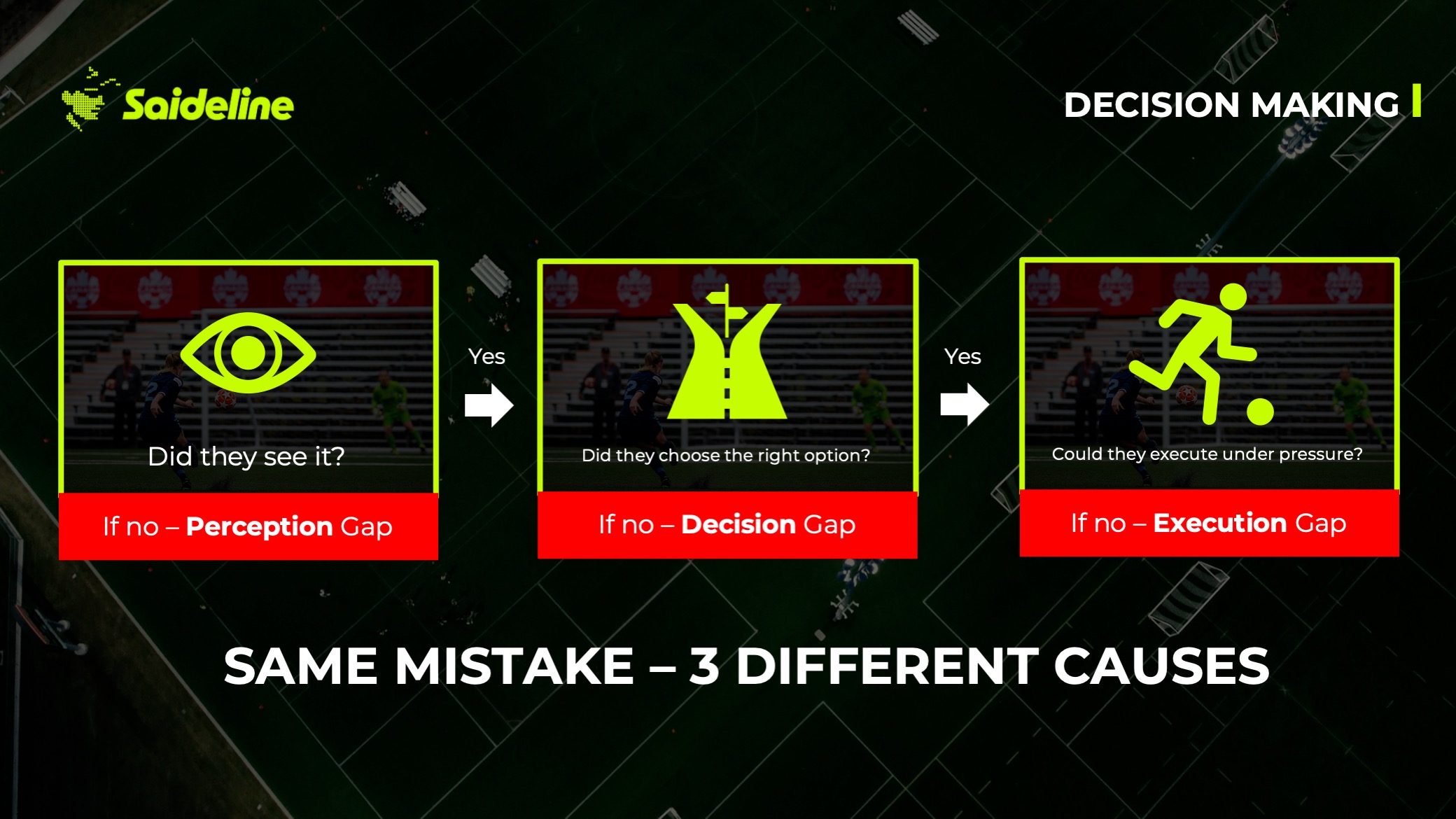
Two players make the exact same mistake in the exact same small-sided game. One of them never saw the free teammate. The other saw him perfectly and still played the wrong pass. If you coach both of them with the same fix, you'll fix one player and waste the other player's rep. Arsène Wenger, in an interview about where football training needed to go next, put his finger on exactly this: "The next step could be speed of decision-making, quality of information taken and the flexibility of decision-making." Three separate things, not one. Most coaching mistakes come from treating them as if they were the same problem.
The Same Mistake Can Have Three Different Causes
When a player does the wrong thing on the ball, it's tempting to reach for the nearest explanation — usually "bad decision" — and design a drill around better decision-making. But a wrong outcome can come from three genuinely different places, and each one needs a different fix:
The player never perceived the option. The information was there, but they didn't see it in time.
The player perceived it correctly but chose the wrong option anyway. They had the picture; they picked the wrong piece of it.
The player perceived it, chose correctly, and still couldn't execute it — because the pressure, the time, or the physical duel was too much in that moment.
Treat all three as "poor decision-making" and you'll spend weeks running the same rondo hoping it eventually clicks. Separate them, and each one points you straight at the right adjustment.
First, Did They Actually See It?
This is the most commonly missed layer, because a missed option and a bad choice look identical from the sideline — both end in the wrong pass. The way to tell them apart is to ask. Right after the rep, ask the player what they saw in that moment. If they describe a picture that doesn't include the option you wanted them to take, you're not looking at a decision-making problem at all. You're looking at a perception problem — the information genuinely wasn't there for them yet.
The fix here isn't more repetitions of the same picture at the same speed. It's temporarily giving the player more time and space to scan: a slightly bigger grid, an extra free touch before pressure arrives, a numbers-up phase before the real numbers kick in. None of this is the finished product — it's scaffolding. Once a player is consistently describing the full picture back to you, you tighten the space again and move to the next layer.
Then, Did They Choose the Right Option?
If the player did see the option and still didn't take it, you're now in genuinely different territory. This is where changing the rules of the game — not the space — does the work. A simple example: in a 4v4 possession game, make a goal scored within two touches of a switch of play worth double. You haven't told anyone how to play. You've made one specific decision objectively more valuable, so players start hunting for it themselves. Small-sided formats built this way are one of the more reliable ways to nudge a decision without dictating the solution outright.
The goal is always to remove that scaffolding as soon as the pattern shows up unprompted. A rule that rewards a decision is a teaching tool, not a permanent fixture — leave it in too long and you're training players to chase bonus points instead of reading the game.
Finally, Can They Execute It Under Real Pressure?
The hardest layer to coach is also the easiest to misdiagnose, because it looks exactly like the first two from the outside. The player saw the option. They chose correctly. And it still went wrong — because the defender closed the distance faster than they could control the ball, or the window to play the pass had already shut by the time they committed to it.
This isn't a seeing problem or a choosing problem. It's a readiness-under-pressure problem, and the only real fix is to rebuild that same decision at progressively higher intensity: a tougher match-up, a tighter grid, a defender who starts with less of a head start each round. Game-realistic 1v1 and 2v1 scenarios are a natural home for this — the picture stays the same, only the speed and pressure around it change.
Reading the Field Before You Change the Drill
The practical version of all this is a habit, not a system. When you see the same mistake repeat across a session, resist the urge to immediately redesign the game. Ask the three questions in order first: What did they see? What did they choose? Could they have executed it? Only change the condition that's tied to the actual answer — more time and space for a perception gap, a rule that rewards the option for a decision gap, tougher pressure for an execution gap.
Coaches who skip this step usually end up doing one of two things: repeating the same fix on a player it was never going to help, or accidentally making a drill easier for a player who needed it harder. Neither gets you closer to the player actually reading the game better on their own.
Try This the Next Time the Same Mistake Keeps Showing Up
Before you touch the drill, ask the player what they saw. That single question will usually tell you which of the three problems you're actually looking at — and which one you'd have gotten wrong by guessing.
If this changes how you diagnose a repeated mistake in your own sessions, share it with a coach who's still redesigning the same drill for every kind of wrong decision.