
How to Build a Soccer Drill That Actually Teaches Players to Break Defensive Lines
Every coach has been there: you set up a nice-looking exercise, the players go through the motions, everybody breaks a sweat — and yet nothing about their decision-making in an actual match improves. The problem is rarely effort. It's usually the drill itself.
If you want a soccer drill to genuinely improve a player's ability to beat a defensive line, it has to be built, not just picked off a template. Below is a practical framework for doing exactly that — grounded in coaching science, and illustrated with a concrete example any youth or amateur coach can steal for Monday's session.
Start With the Question, Not the Cones
Before you draw a single cone on the whiteboard, ask: what decision am I actually trying to train?
In modern football, the ability to break through opposition defensive lines — what analysts now track under metrics like "Packing" or "line-breaks" — is one of the clearest indicators separating winning teams from losing ones. Teams that reach the box having played through fewer remaining defenders create better chances, full stop. So a genuinely useful soccer drill for this theme isn't really about technique in isolation. It's about teaching a player to recognize the moment a pass, a dribble, or a run can eliminate opponents from the game — and to execute it under realistic pressure.
That distinction matters more than it sounds. A pure passing pattern with no defender is a technical exercise, not a soccer drill in the tactical sense. It grooves a movement, but it strips out exactly the information — timing, distance, direction of the opponent — that a player needs to actually break a line in a match. That's the same gap that separates drills that look good in training from drills that actually transfer to match day.
The Three Questions Every Drill Must Answer
A well-designed training form always has to answer three questions, in this order:
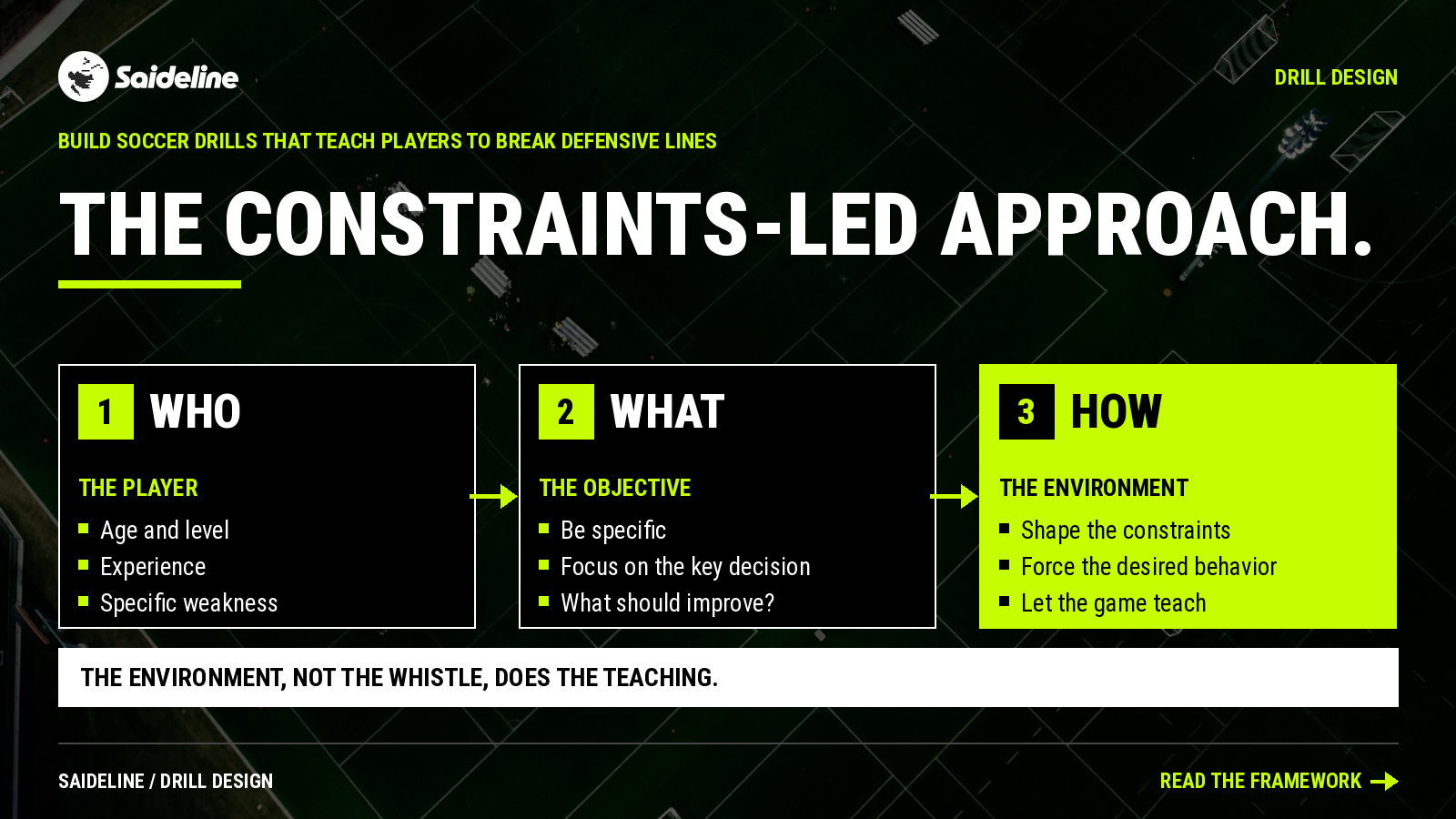
1. WHO is this for? What's the player's level, age group, and specific weakness? A drill for a technically raw 12-year-old looks nothing like one for an experienced U19 player who already scans the field but makes the wrong final decision. Design starts with the player, not the exercise.
2. WHAT should they get better at? Be brutally specific. "Improve attacking play" is not a training objective. "Receive the ball facing forward instead of with the back to goal, so the next action doesn't lose tempo" is.
3. HOW will the environment force that behavior? This is where most drills fall apart. Coaches often tell players what to do instead of building a situation where the right choice is the only good one. The environment — not the whistle — should do the teaching.
Why Small-Sided Overloads Beat Isolated Passing Patterns
If breaking a line is fundamentally about reading opponents and teammates, then a soccer drill without opposition can't really train it — at best it trains the pass itself. To force a player to actually process pressure, positioning, and timing, you need at least a realistic attacker-vs-defender relationship on the pitch.
A 2v1 or 3v2 overload is a sweet spot for many youth and amateur groups: it's small enough to run with limited players and space, but it still forces the player on the ball to read a real defender's movement, communicate with a teammate, and make a genuine decision — rather than executing a memorized pattern.
A Concrete Example: 3 versus 2 + 1
Organization and procedure:
Set up two dribbling goals with a length of 2 meters on each baseline. Position a starting cone 2 meters behind the baseline. Distribute the players in the positions.
The coach plays a pass to any player on the baseline. With this pass, the coach determines the right to attack (here red). The pass is played 3 against 3. Due to the delayed start of a defender, the attackers have a short-term superiority.
Coaching points offensive:
- In the short superiority, force a fast vertical game
- The attackers occupy both sides in depth
The Takeaway
A good soccer drill isn't a shape you copy from a coaching manual — it's a small, well-aimed question you ask your players, disguised as a game. Get the "who," "what," and "how" right, build in real opposition, and let the environment — not your voice — do most of the teaching. Once you have your drills, here is how to plan a soccer practice around them.