
Defending a give-and-go is one of those moments coaches talk about constantly and almost never get to actually coach live, because it doesn't show up on command. You can tell a defender "don't step in too early, the ball's about to come straight back to the same player" a hundred times on the whiteboard, and it still won't sink in until they've felt the exact moment happen to them, over and over, in a picture designed to produce it. Bill Shankly described the game itself in almost exactly those terms: "Football is a simple game based on the giving and taking of passes, of controlling the ball and of making yourself available to receive a pass. It is terribly simple." Give it back, then get open again — that's the whole combination in one sentence, and it's exactly what this game is built to produce on repeat.
The Game: A 1v1 That Flips Into the 2v1 That Matters
Setup
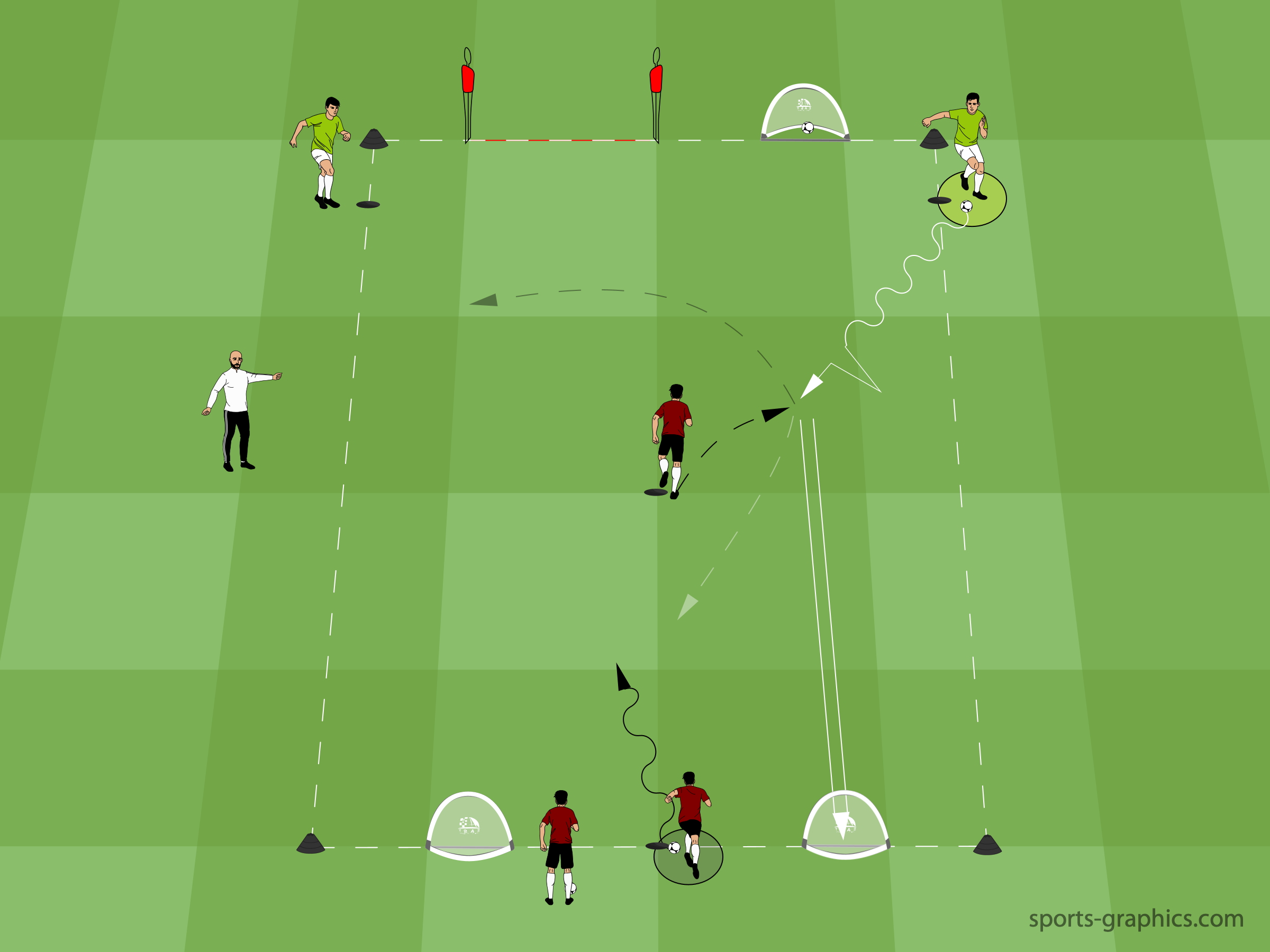
Set up two mini goals at one end of a small grid. At the other end, place a single mini goal alongside a dribble line as a second target. You need three players to run the sequence: an initial attacker, an initial defender, and a third player who joins once the first phase ends.
How it plays
It starts as a straightforward 1v1: the attacker takes on the defender toward the two mini goals at the first end and takes a shot. The instant that action finishes, the roles flip completely. The player who was just attacking becomes the lone defender. The player who was just defending teams up with a new attacker — who starts from between the two mini goals — and together they attack the other end, 2v1, aiming at the single mini goal and the dribble line.
The rule that does all the work
Here's the detail that makes the whole thing click: only the player who's actually dribbling the ball is allowed to score. A teammate can't just receive the final pass and finish — if they're not the one who carried the ball in, the goal doesn't count. That single restriction forces the two attackers into a real give-and-go: the dribbler has to release the ball to their teammate to escape the defender's pressure, then immediately get open again to receive it back and keep carrying it themselves, because they're the only one who's allowed to finish. It's not a rule you have to explain twice — players find the pattern themselves within a few reps, because it's the only pattern that actually works.
What to coach
On the attacking side, watch the timing of the release pass and the run that follows it — a give-and-go played too early gives the defender time to recover and cut the return pass, and one played too late means the dribbler never escaped the pressure that made the pass necessary in the first place. On the defending side, this is where the real coaching payoff sits: the defender has to resist committing fully to the ball the moment it's played away, because that's exactly when the return pass arrives. Coach the delay — showing the dribbler onto their pass, then recovering into the passing lane for the return ball, rather than sprinting the wrong way the instant the ball leaves their opponent's foot.
One Format, Every Age Group
The setup and the rule don't need to change across age groups — only how much you say about them does. With younger players, explain the two phases and the one restriction clearly, then let them play. They'll usually stumble into the give-and-go pattern through pure repetition without you ever having to name it, and that discovery sticks better than a lecture would. With older and more advanced players, you can be a lot more direct about why this matters right now: modern defending leans heavily on aggressive, man-oriented pressing, which means defenders get isolated in exactly this kind of 1v1 or 2v1 far more often than they used to. Naming that connection explicitly — "this is the exact picture you're in every time your team presses man for man and gets bypassed by one pass and a return ball" — gives experienced players a reason to care about a detail that would otherwise just look like a small drill rule.
Try This the Next Time You Want to Coach the Give-and-Go Live
Most coaches try to defend the give-and-go by describing it after the fact. This flips that — the rule manufactures the exact moment you want to coach, on a loop, until reading it becomes automatic instead of theoretical.
If this changes how you coach that moment, share it with a coach who's still trying to explain the give-and-go from the sideline instead of building a game that produces it.