
Most 1v1 soccer drills teach a player what to do when the duel is calm: a defender stands in front, the attacker has all day to pick a move. A match rarely works like that. The duel arrives from the side, at speed, with a teammate shouting and a goal behind it. The five games below put that pressure into training: a clock, a score, a league table or a partner waiting to tag in.
They are competitive formats, built so players want to win the duel rather than complete it. If you already have a calmer starting point, our honest 1v1 scenarios cover the tactical side, and these games are the natural next step.
Why Distance Decides the Duel
Before the games, one idea that changes how you coach them: the gap between attacker and defender before the duel starts matters more than any single move. The larger that gap, the more likely the attacker wins, because speed is harder to match than a feint. So 1v1 soccer drills that only start at arm's length train half of the picture.
A useful way to sort the situations: a frontal duel, a duel from the side, a running duel to the ball, and a duel with the back to goal. Each asks the attacker and defender for something different, and the games below mix them without you having to stop and explain.
Game 1: Hold the Ball for Five Seconds
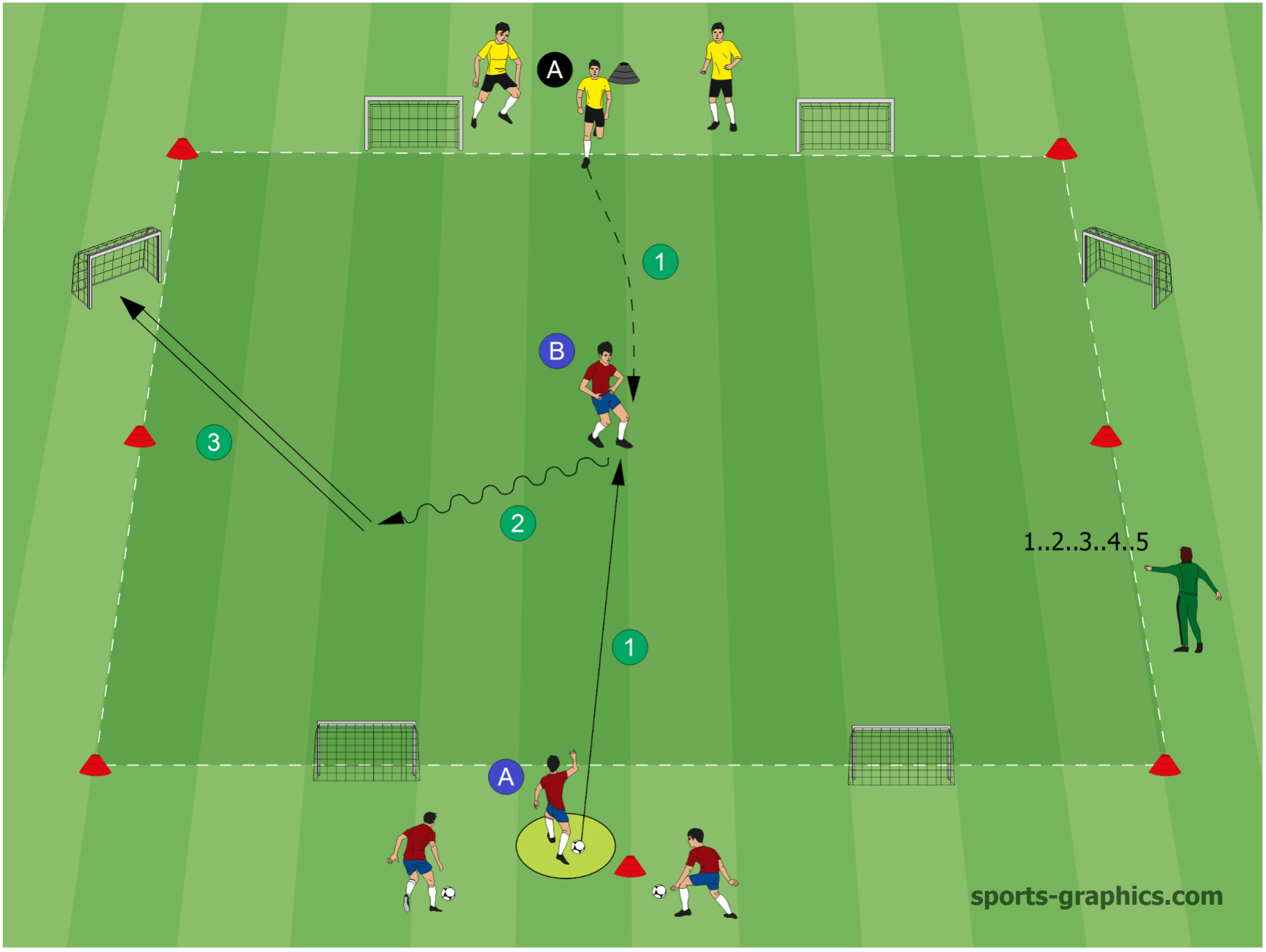
Mark a small field with four mini goals at one end and two at the other. Player B stands in the middle and receives a pass from A. The moment the pass is played, A may press. The coach counts down five seconds out loud, and B is not allowed to shoot until the count ends. After that B finishes on one of the four far mini goals. If A wins the ball, A counters on the two mini goals behind. Then the players swap roles.
What to coach: The attacker shields the ball with the body or with quick feints, depending on the player type. The defender learns when to commit and when to stay patient.
Variation: Let the defender score points after winning the ball, with extra points for a goal, so both roles have something to play for.
Game 2: Tag-Team 1v1 Tournament
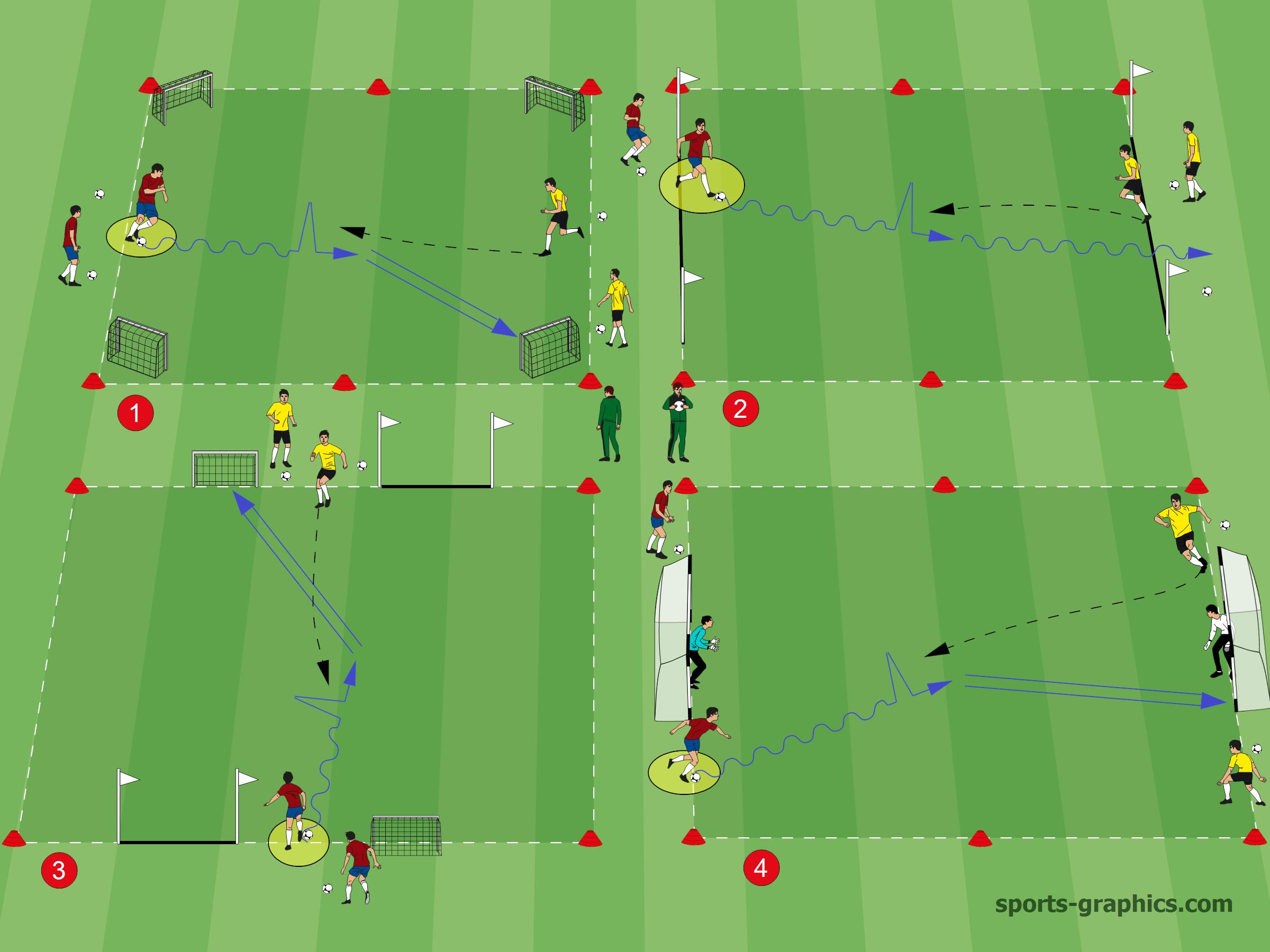
Build four small fields, each creating a 1v1, and form teams of two. Inside each field the pair works in tag-team mode: a player can swap with his partner at any moment by passing the ball to him on his own baseline. Each round lasts two minutes, then one team moves clockwise and the other counterclockwise. All goals from every round are added up, and a tie goes to a final in one field.
What to coach: Each field asks for different behavior. In a field with a dribble line, defending can be strategic. In a field with two large goals, the pressure on the ball matters because a shot is always possible. The tag-team rule also teaches players when they're too tired to win the next duel and should hand over.
Game 3: Champions League
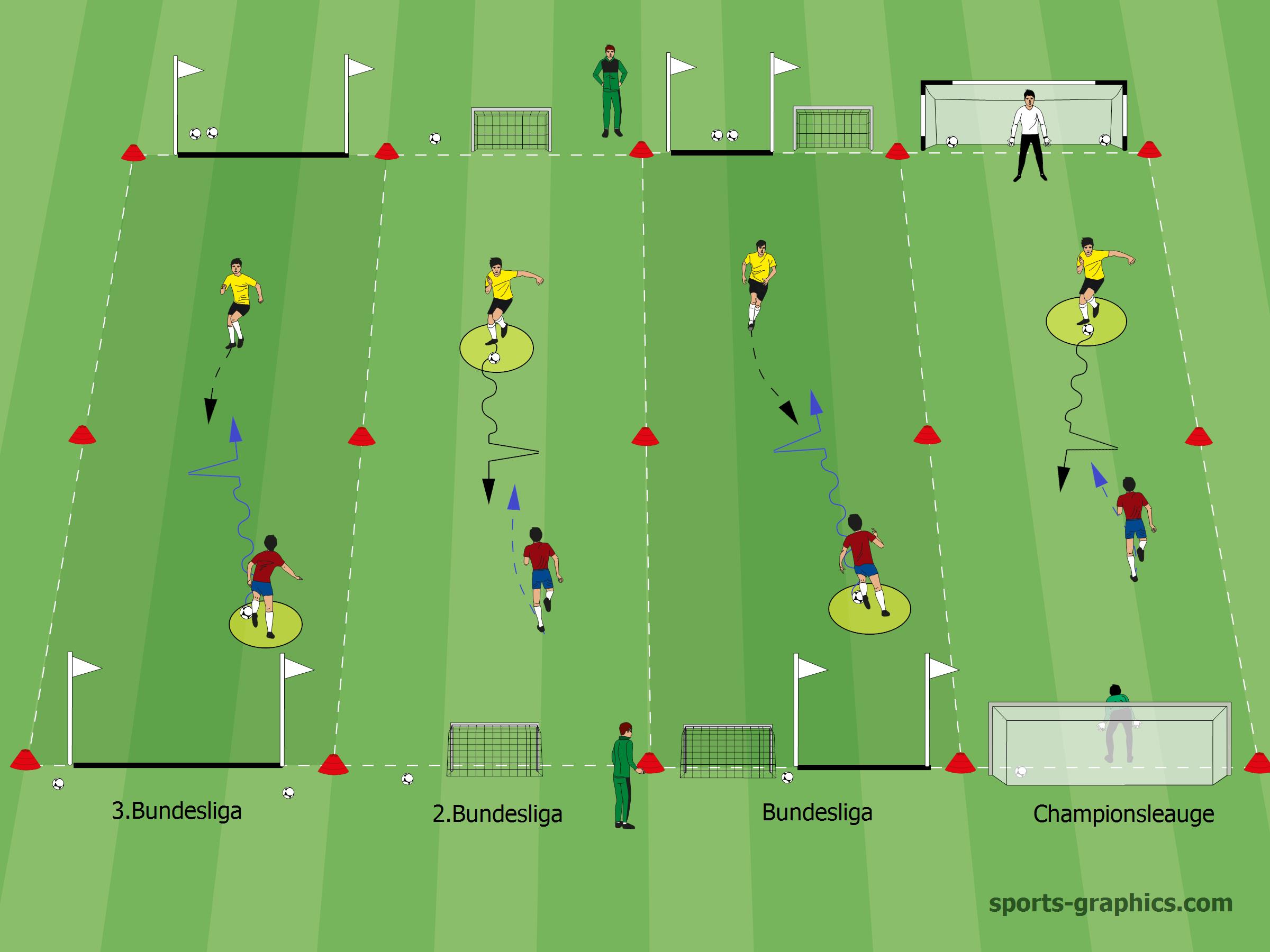
Set up four fields with different finishing targets and play 1v1 in all of them. A round lasts one minute. After each round, the winner of each field moves up a league and the loser moves down. If a duel ends level, the player who scored last wins. Play ten rounds and find out who wins the final.
What to coach: Almost nothing, and that's the point. The coach acts as a referee and lets the pressure do the teaching. Of all the 1v1 soccer drills here, this one asks the most of a player's mentality: they learn to stay composed after a loss, because the next round is already starting. You can run the same format in tag-team mode.
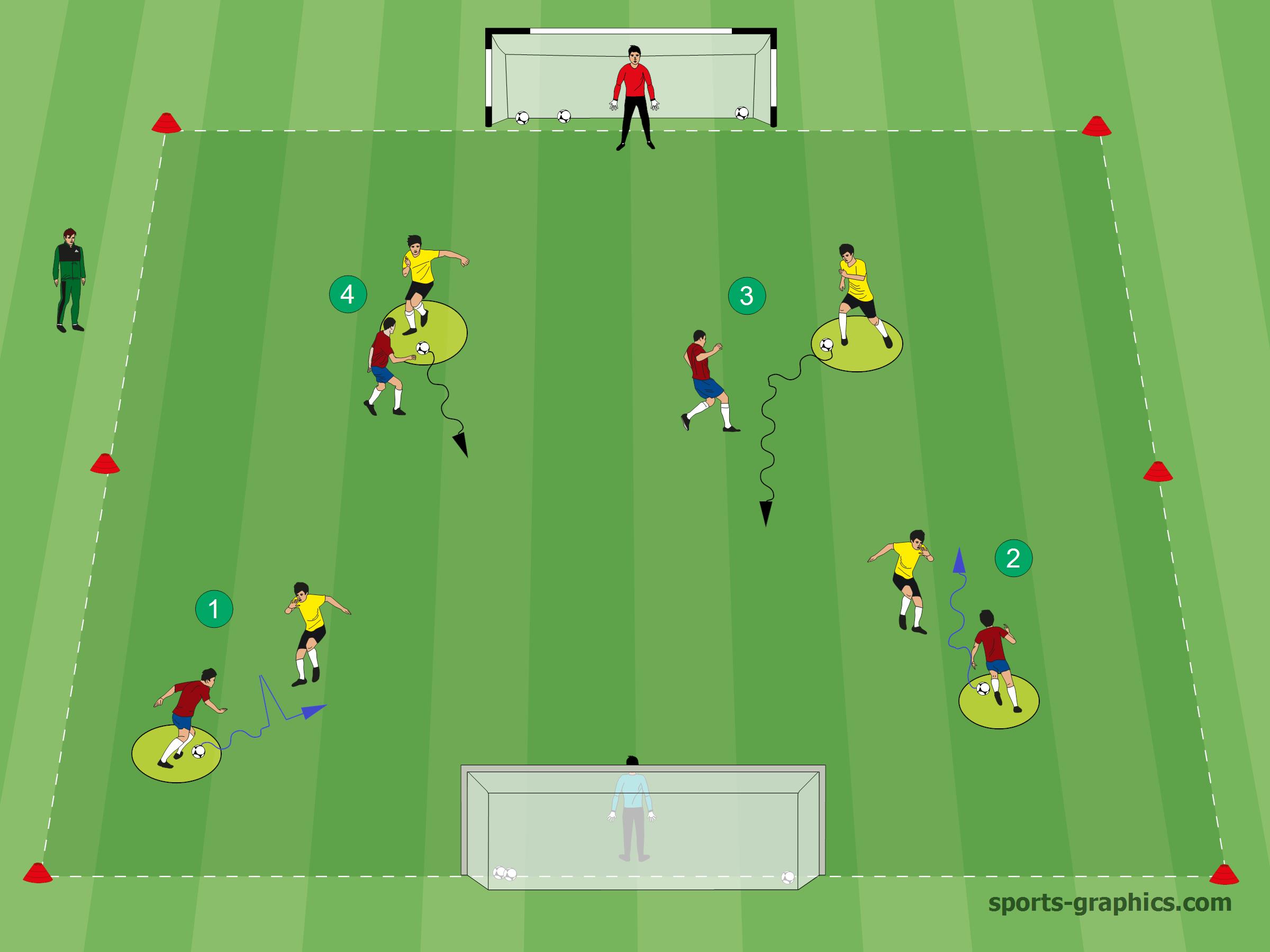
Game 4: Four 1v1s in One Field
Use one field with two large goals and goalkeepers. Form four or more pairs, and let them play independent duels at the same time for one minute. The goalkeepers hand out new balls after each shot. After the minute, build new pairs. Who scores the most?
What to coach: Players should use the chaos: other duels become obstacles, and two players can even finish on the same goal at once. It trains scanning, because a 1v1 in a match is never as isolated as it looks in a drill.
Variation: A scorer stays in the field and helps a teammate, which creates a 2v1 against the player who just conceded. The beaten defender leaves the field.
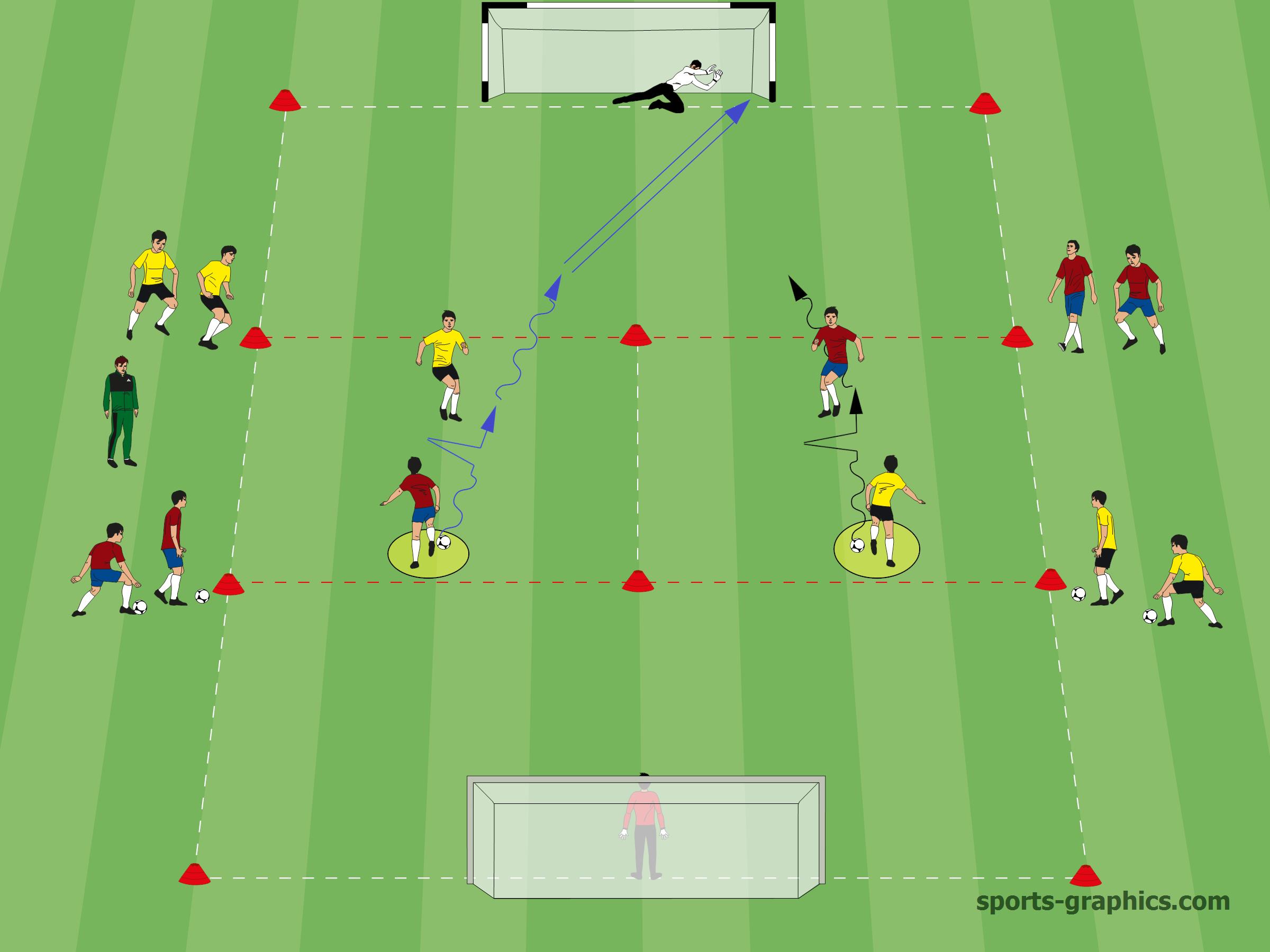
Game 5: Who Wins the Duel Faster?
Mark a field with two large goals and two middle zones. In each zone, two groups play 1v1 in the same direction at the same time. Only the player who crosses the red line first is allowed to finish on the big goal, and the rule also applies after a turnover.
What to coach: Both players must take more risk in the duel, because the race to the line simulates match pressure. Attackers learn to accelerate early, defenders learn to close the gap before it becomes a sprint.
Individualizing by Position
A fullback is mostly decided by duels from the side and running duels. A winger lives in frontal duels with a gap. A striker needs the back-to-goal situation from the first game, where shielding the ball and turning against an opponent who stays close is the whole job. Center backs benefit most from the defender's side of every game: finding the point where they stop moving forward and match the attacker's speed.
Used together, these 1v1 soccer drills can fill a whole session: start with the hold-the-ball game for tactical detail, move to the tag-team format for volume, and finish with the league as a competition. For the finishing side of these duels, see our 1v1 shooting games. If you want to coach the defender's job in a 1v1 that turns into a 2v1, try the give-and-go defending drill.